Intelligent Estate Governance Maturity Model
Advancing AI governance and cybersecurity standards across AV/IT, Digital Workplace, and Smart Buildings.

The Intelligent Estate Governance Maturity Model provides a structured, five‑level pathway for organisations to assess, benchmark, and improve their readiness for AI‑enabled AV/IT, Digital Workplace, and Smart Building environments. It connects technology operations with modern AI governance, cybersecurity standards, and emerging regulatory requirements, helping organisations build safer, auditable, and autonomous‑ready estates.
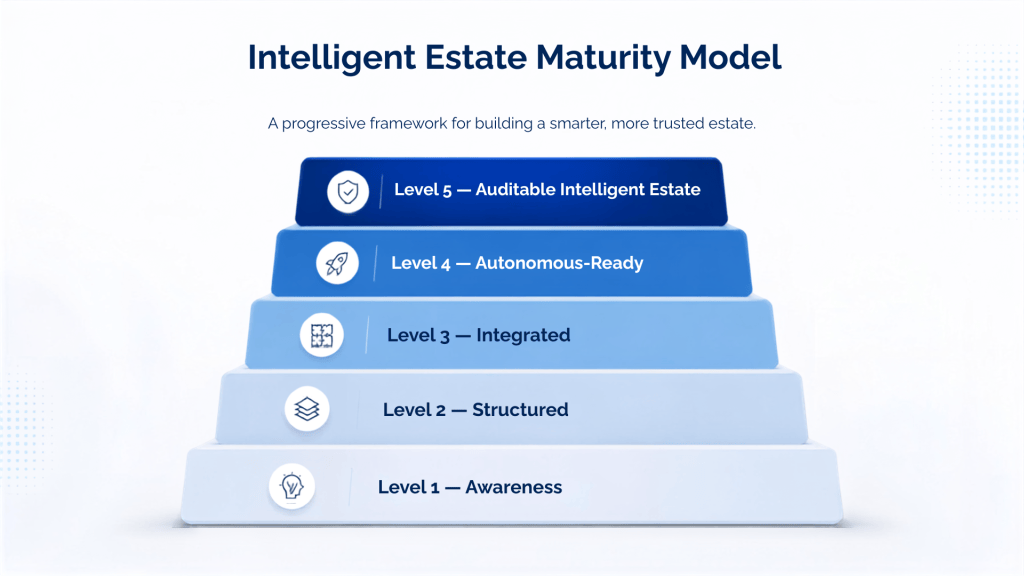
As AV/IT systems become increasingly autonomous, governance maturity determines whether estates remain secure, compliant, and trusted. This model helps organisations benchmark readiness and align with ISO 42001, NIST AI RMF, and the EU AI Act.

Level 5 — Auditable Intelligent Estate
Meaning: The estate achieves full alignment with global AI‑governance standards such as ISO 42001, NIST AI RMF, and the EU AI Act. Autonomous systems generate complete audit logs, self‑report anomalies, and demonstrate continuous compliance without manual intervention.
Why it matters: Auditable intelligent estates operate with high resilience, transparency, and trust. AI systems flag deviations before they escalate, compliance is automated, and governance teams gain full visibility across AV/IT and smart‑building domains.
Next step: Embed automated compliance workflows, predictive risk analytics, and estate‑wide governance culture. Maintain certification readiness and continuously refine governance as AI capabilities evolve.
Real‑world example: An enterprise achieves ISO 42001 certification across its smart‑building estate, with autonomous systems generating audit logs, reporting anomalies, and demonstrating continuous compliance — enabling the organisation to operate a fully auditable intelligent environment.

Level 4 — Autonomous
Meaning: The estate is prepared for AI‑enabled automation but maintains human‑in‑the‑loop oversight. Governance processes include escalation paths, audit trails, and structured decision‑making for autonomous systems. AV/IT and smart‑building platforms share governance data in real time.
Why it matters: Autonomous‑ready estates prevent uncontrolled automation and ensure accountability. Human oversight ensures that AI‑driven actions — such as automated diagnostics, device remediation, or environmental adjustments — remain aligned with organisational policy and ethical boundaries.
Next step: Implement continuous monitoring, automated alerting, and estate‑wide audit trails. Strengthen oversight mechanisms to ensure autonomous systems operate within defined governance constraints.
Real‑world example: A global organisation deploys AI‑driven meeting‑room diagnostics and automated device remediation, but every autonomous action is logged, reviewed, and approved through a governance workflow — ensuring safe and compliant automation.

Level 3 — Integrated
Meaning: Governance spans AV/IT, workplace, and smart‑building systems, with shared policies, shared tools, and shared accountability across the estate. AV processors, meeting‑room systems, identity platforms, and building‑management gateways all feed into a unified governance structure.
Why it matters: Integration enables coordinated incident response and controlled change management. All domains see the same risk signals at the same time, reducing downtime and eliminating governance blind spots.
Next step: Formalise cross‑departmental governance committees to align AV, IT, Workplace, and Facilities on incident handling, change approvals, and risk posture.
Real‑world example: A multinational enterprise deploying unified risk dashboards that pull telemetry from AV devices, meeting‑room systems, identity platforms, and building‑management sensors — giving governance teams a single view of cross‑domain risk for the first time.

Level 2 — Structured
Meaning: Early governance policies exist, but AV, IT, Workplace, and Facilities still operate in silos. Teams log incidents and define basic change‑control rules, yet each domain uses its own tools and workflows.
Why it matters: Fragmented oversight creates inconsistent compliance and uneven risk visibility. Issues are recorded but not shared, and changes happen without cross‑domain coordination — slowing response and limiting governance maturity.
Next step: Standardise incident logging, change‑control, and AI‑risk reporting across all departments to build unified, cross‑domain governance.
Real‑world example: A corporate AV team starts documenting incidents and device‑change approvals, but IT, Workplace, and Facilities track issues separately. Policies exist, yet compliance varies because the estate is not unified.

Level 1 — Awareness
Meaning: Organisations recognise emerging AI, cybersecurity, and operational risks across AV/IT and smart‑building systems, but governance is informal and undocumented. Issues are handled reactively, and there is no consistent method for logging incidents or assessing risk.
Why it matters: Without structured governance, incidents repeat, lessons are lost, and risk visibility remains low. Teams operate independently, creating blind spots that make the estate vulnerable to outages, misconfigurations, and AI‑driven anomalies.
Next step: Establish basic governance policies, define accountability, and introduce simple incident‑logging practices to begin building a foundation for structured oversight.
Real‑world example: A regional AV integrator responds to device failures and meeting‑room outages as they occur, but no incidents are documented and no root‑cause analysis is performed — leaving the organisation exposed to recurring issues.
 The AV Governance Report